If you've got a job and you earn a bit on the side, whether that's delivery driving, selling stuff, or odd jobs, there's one number worth knowing before the tax year ends. It's £1,000.
I deliver on the side myself, so I've had to get my head round this. I'm not an accountant, so this is how it works in plain English. Check gov.uk (I've listed the pages I used at the bottom) for your own situation.
What the trading allowance is
The trading allowance lets you earn up to £1,000 a year from self-employed work without paying tax on it. It covers things like self-employment, casual services and hiring out your own equipment.
It's based on your gross income. That's everything you were paid, before any costs come off.
- If your gross trading income for the year is £1,000 or less, you generally don't need to tell HMRC. There are exceptions, so check.
- If it's over £1,000, you need to register for Self Assessment. You do this by 5 October after the tax year ends.
The catch: it's either or
Once you're over £1,000, you've got a choice. You can use the trading allowance, which means you knock £1,000 off your income and that's it. Or you can claim your actual expenses instead.
You can't do both. If you use the allowance, no other expenses.
So the question is simple. Are your real costs more than £1,000? If they are, expenses win. If they aren't, the allowance wins.
For drivers there's a third option that makes this easier. HMRC lets you claim a flat rate per mile instead of tracking fuel, repairs and insurance. For the 2026/27 tax year that's 55p a mile for the first 10,000 business miles, then 25p after that. It covers the running costs of the vehicle, so you can't claim fuel on top.
A worked example
Let's use made-up numbers, not mine. Say you've got a full-time job paying £35,000. That uses up your £12,570 personal allowance, so extra money from a side hustle is taxed at the basic rate of 20%.
Over the 2026/27 tax year you earn £6,000 from delivery apps and drive 5,000 business miles.
Option 1: trading allowance
- £6,000 minus £1,000 = £5,000 taxable profit
- Tax at 20% = £1,000
Option 2: mileage claim
- 5,000 miles x 55p = £2,750
- £6,000 minus £2,750 = £3,250 taxable profit
- Tax at 20% = £650
Mileage comes out £350 better. Same income, same work, just a different box ticked.
Now flip it. Say you only drove 1,200 business miles. At 55p that's £660, which is less than the £1,000 allowance. This time the allowance wins.
If you only claim mileage with no other costs, the crossover is roughly 1,820 miles over the year. Below that, the allowance is usually better. Above it, mileage is. Your own costs might change that, which is why it's worth working out both.
What about National Insurance?
If you're self-employed, you pay Class 4 National Insurance on profits over £12,570. For 2026/27 it's 6% on profits between £12,570 and £50,270, and 2% above that.
In the example above, the profit is nowhere near £12,570, so there's no Class 4 to pay. It only starts to bite when your side hustle gets properly big.
Things people get wrong
- Forgetting to keep records. Even if you use the allowance, you need to keep a record of your income. A spreadsheet is fine.
- Mixing methods. You can't take the allowance and claim expenses for the same trade.
- Working it out at the last minute. If you've not tracked miles all year, you're guessing in January. Not fun.
- Scotland. The income tax bands are different there, so the numbers above won't match.
Keep it simple
The easiest way to get this right is to log your income and your miles as you go, then compare both routes at the end of the year.
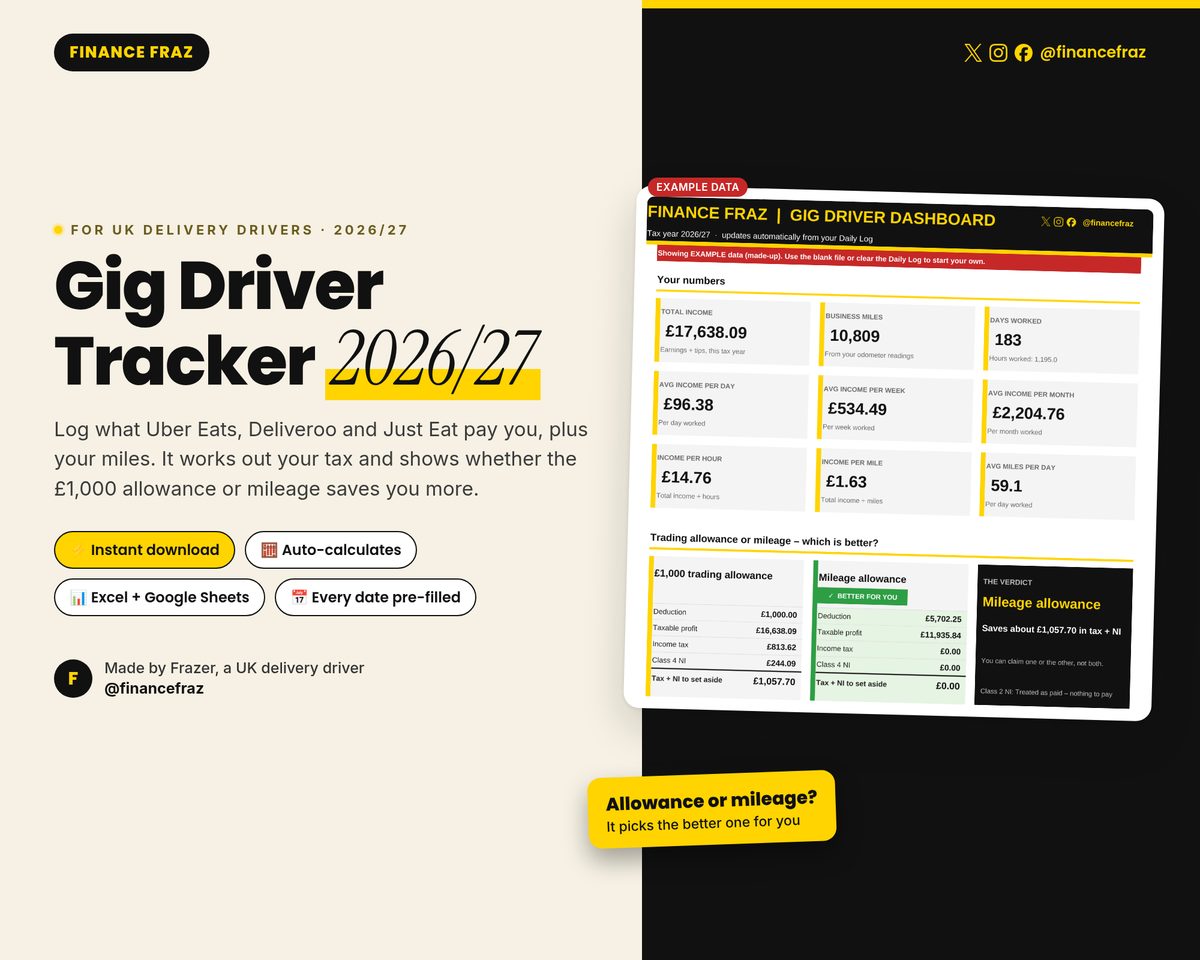
That's why I built the Delivery Driver Tax Tracker. You fill in what each app paid you, your hours and your odometer readings, and it works out your tax both ways and shows which comes out lower. It's £4.99 and works in Google Sheets and Excel.
I'm also working on a Side Hustle Tax Tracker for people who don't drive for a living. That's coming in January, and newsletter readers will hear first.
Not financial or tax advice. I'm not an accountant or a regulated adviser, I'm a UK dad sharing how this works. The figures are for the 2026/27 tax year unless I say otherwise, and rules change, so check gov.uk or ask an accountant about your own situation.