If you deliver for Uber Eats, Deliveroo or Just Eat in your own car, the car costs you money every shift. Fuel, insurance, servicing, tyres, it all adds up.
The good news is HMRC lets you claim for it. The better news is there's a simple way to do it, if you keep track of your miles.
I do delivery on the side myself, so I've had to learn this properly. I'm not an accountant, so check gov.uk for your own situation.
The rates for 2026/27
For cars and vans, the flat rate per business mile for the 2026/27 tax year (6 April 2026 to 5 April 2027) is:
- 55p a mile for the first 10,000 business miles
- 25p a mile after that
Before 6 April 2026, the first 10,000 miles were 45p. So if you're doing a Self Assessment return for last tax year, it's 45p, not 55p. Motorcycles are 24p.
What it covers
The flat rate is instead of working out your actual costs of running the vehicle. That means fuel, insurance, repairs and servicing.
So you pick one. Either the flat rate, or your real costs. You can't claim fuel on top of the 55p, because it's already in there.
What you can claim on top is parking and other travel costs, like a train fare. And if you use the trading allowance instead, you can't claim any expenses at all.
Two rules to know:
- Once you use the flat rate for a vehicle, you have to keep using it for that vehicle while it's in the business.
- You can't use it if you've already claimed capital allowances on that vehicle.
A worked example
Made-up numbers, not mine. Say you've got a full-time job paying £35,000, so your side income is taxed at the basic rate of 20%.
Over the year you earn £9,000 from delivery apps and drive 8,000 business miles.
Trading allowance
- £9,000 minus £1,000 = £8,000 profit
- Tax at 20% = £1,600
Mileage claim
- 8,000 miles x 55p = £4,400
- £9,000 minus £4,400 = £4,600 profit
- Tax at 20% = £920
That's £680 less tax for the same job, and all it took was a log of your miles.
What if you go over 10,000 miles? Say you do 12,000 miles. The first 10,000 are 55p, which is £5,500. The other 2,000 are 25p, which is £500. Your claim is £6,000.
(HMRC's own example on gov.uk is 11,000 miles, which comes to £5,750.)
Which miles count?
This is where people get it wrong. You can only claim business miles, not personal ones. A trip to the shops in between orders doesn't count.
Miles between pickups and drop-offs are clearly business. The journey from home to your first pickup is trickier, and I'd check HMRC's guidance or ask an accountant rather than guess.
Whatever you decide, keep a note of how you worked it out.
Keep a log
HMRC expects you to keep records of your business miles. Write down the date and your start and end odometer readings, or use a mileage app. Don't try to rebuild it from memory in January. Nobody remembers what they drove in June.
Also, watch out for the trap in the other direction. If your business miles are low, the flat rate might not beat the £1,000 trading allowance. Work out both. If you only claim mileage and have no other costs, the crossover is around 1,820 miles a year.
The easy way
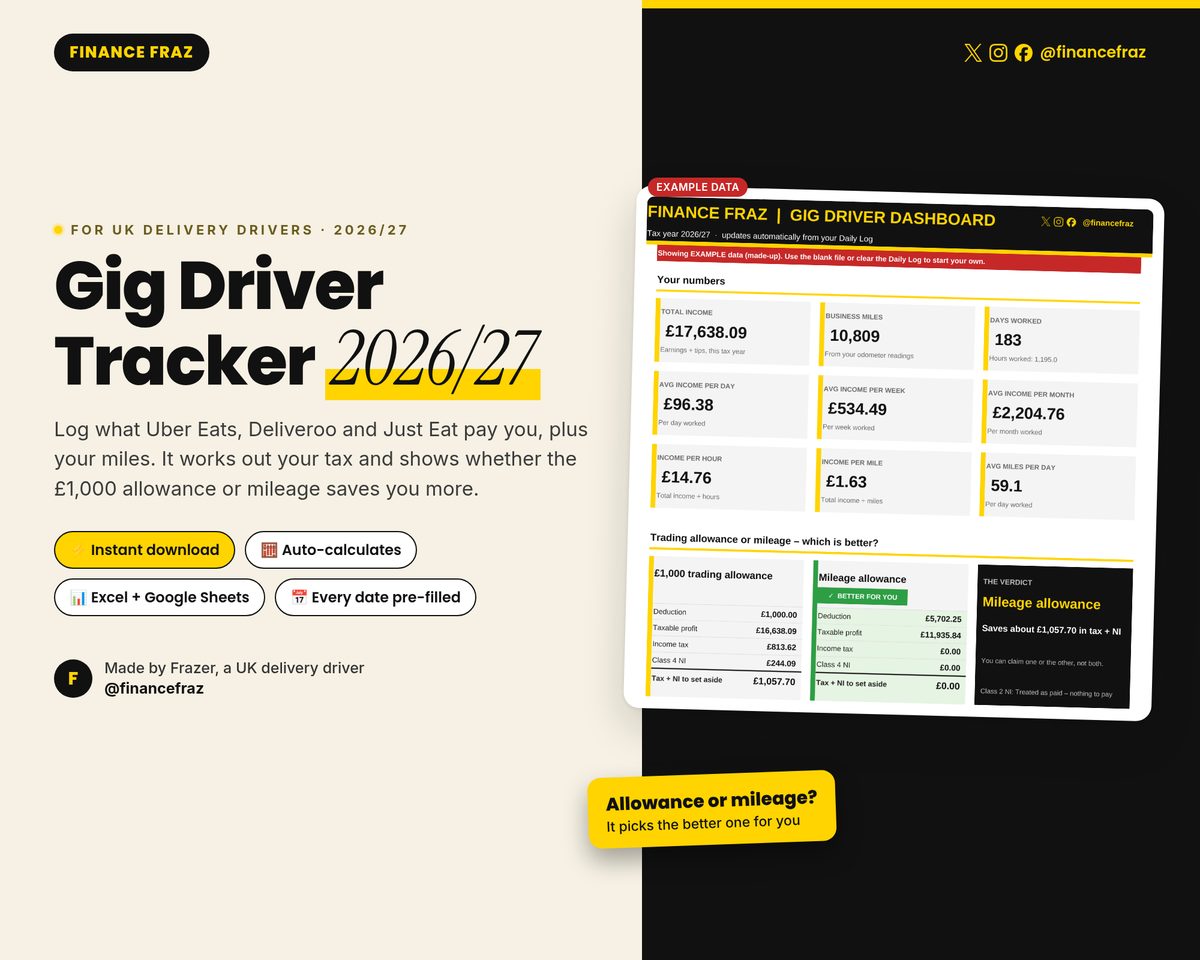
That's the reason I made the Delivery Driver Tax Tracker. Every day of the 2026/27 tax year is already in the sheet. You add what each app paid you, your hours and your start and end odometer. It works out your miles and your totals, then shows the estimated tax and National Insurance both ways, so you can see whether the allowance or the mileage claim leaves you better off.
It's £4.99 and works in Google Sheets and Excel. It uses England, Wales and Northern Ireland rates.
Not financial or tax advice. I'm not an accountant or a regulated adviser, I'm a UK dad sharing how this works. The figures are for the 2026/27 tax year unless I say otherwise, and rules change, so check gov.uk or ask an accountant about your own situation.